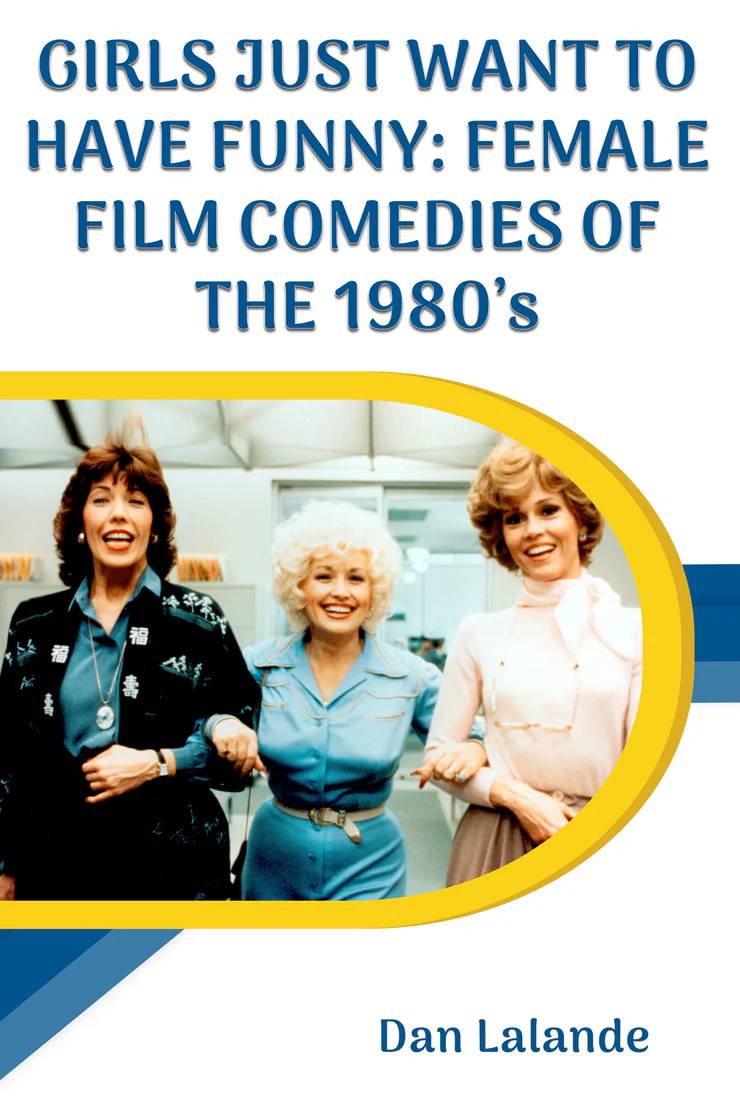
Girls Just Want to Have Funny:
Female Film Comedies of the 1980’s
An examination of the female film comedy movement of the 1980’s, profiling the lives and work of the actors and auteurs behind this historically unheralded period.
Excerpt from the book:
Girls Just Want to Have Funny:
Female Film Comedies of the 1980’s
Michelle Pfeiffer
Come the ‘80s, a very retro period, the dumb blonde made an interesting comeback. That said, while this new breed maintained, to a greater or lesser degree, the type’s imminently identifiable little-girl-lost quality, she came with timelier, more admirable aspects. She might have still looked like the world’s plaything, but underneath, she was, in the business parlance of that business-centric time, ready to take on the world. And not just using her feminine wiles; that, as Monroe had definitively proved, could only get you killed. Her successors would settle for hurt, sometimes deeply, as long as it transformed them into stronger, more independent forces.
To wit: Michelle Pfeiffer.
Pfeiffer came off the superficial blonde assembly line that hadn’t been in operation for almost two decades or had proven, in small, supporting sizes, frustratingly unfit for the world (best example: Teri Garr). She was a Miss Orange County in 1978, then came in sixth in that year’s Miss California contest. Further, even though she’d set her sights on appearing in the movies, she never bothered to take an acting lesson. So, combined with how limited or embarrassing her early roles were, who could blame us for writing her off as mere eye candy?
And yet, the savvier of us (myself only semi-included) recognized a scrappy, working-class spirit and self-preserving smarts that could not be entirely compromised by stereotyping. Increasingly, her presence reminded us of Cocteau’s line about the ticking of a watch on the arm of a dead soldier: something small but active was at work amidst the circumstantial lifelessness. We just had to wait and see, film by film, if it would be permitted to develop.
As the films piled up, most on the sorry side, the answer to our anticipation seemed to be no. We began to grow a little frustrated with her…or was our qualm with the industry? Was it her, it, or both that were barricading the floodgate? Finally, with the exaggeratedly earnest Scarface, we started to see it happen: proof positive of that great impossibility, that one could be strikingly beautiful and a talent with which to be reckoned at the same time, much like when Monroe had played jack-in-the-box in Bus Stop (1956). Pfeiffer transcended De Palma’s showy gore, Pacino’s grand guignol, and the film’s Mickey Mouse politics. We gave our hearts to the trapped, wasted beauty she created in that film the way we hadn’t in a long, long time, the way we had to alcoholic chanteuse Claire Trevor in an older, superior gangster flick, Key Largo (1947). Then came films that, finally, convinced us we weren’t idiots: The Witches of Eastwick, Dangerous Liaisons (1988), and The Fabulous Baker Boys (1989), the latter echoing not Claire Trevor but, from another classic (Gilda, 1946), Rita Hayworth.
In all of them, dark-souled, diminutive Michelle was sexy, pushy, desperate, and winning. Her characters operated within a bubble, forced to protect themselves from the world lest it denigrate her, bringing on the burden of self-reliance, a necessity her shaky disposition never appeared entirely ready for. It’s the very dilemma of the sex object looking to be taken seriously, subverted into the stuff of drama. Each role, then, is a personal history. Each part tells us of her tug of war, of the personal and professional collision between appearance and acceptance.
And like the endless big screen blondes before her, while yes, she could be vulnerable, she could not be crushed. Reduced, yes, set back, definitely. But outright destroyed, like Monroe, never. In this, Pfeiffer’s fundamental indefatigability embodied an important aspect of the new spirit of feminism. Go ahead, she told the world, toy with me, use me, lower me to your basest standards. In the end, though, you’ll feel the toll of that more than I will. You, showy-pushy Scarface, or you, ruler of Eastwick, or you, the younger Baker brother, will be the one left with the biggest hole in your heart. I’ll be perforated, for sure, but I’ll mend. Don’t count on you ever being a single piece again. Put less poetically, in Pfeiffer’s films, women win—and the prize is themselves. Unlike other female actors of that time, she was happy to play victims. Caveat: as long as it brought on an inner struggle that got her, at a cost, to a more refined version of herself.
Available at: