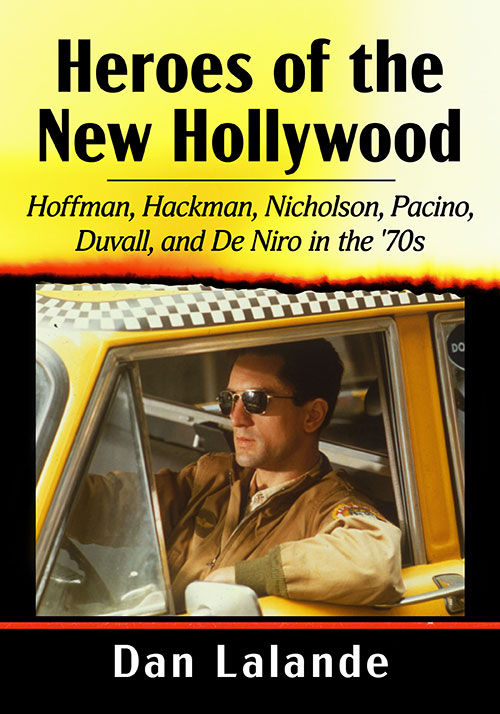
Heroes of the New Hollywood
Hoffman, Hackman, Nicholson, Pacino, Duvall, and De Niro in the ’70s.
“Lalande’s conclusions about the enduring power of these performances are well worth reading. This is a valuable exploration of these cinematic legends’ impact on film and popular culture.” – Library Journal
“…an intelligent, enlightening account of an important period in cinematic history from the perspective of seven important actors. It belongs in libraries, research centers, and any film buff’s collection.” – James L. Neibauer, film historian and author
“The book ranks right up there with Peter Biskind’s classic Easy Rider, Raging Bulls.” – Booklist
Excerpt from the book:
Heroes of the New Hollywood:
Hoffman, Hackman, Nicholson, Pacino, Duvall, and De Niro in the ‘70s
Robert De Niro – Avenging Angel
There is a lonely quality to Robert De Niro, the ghostly ambling of a dissatisfied urban seeker, trying to make sense of the world, himself, and how the two might live in harmony. His characters are perpetually boarded up in a cave of solitude, a room of rumination, of half-thoughts, of I don’t knows, and yeahs, and maybes—much like the answers De Niro the person, a notoriously tricky interview, affords, when he so deems, the press. It has the vibe of a fallen angel, a holy presence sent to earth to take in humanity, have his heart broken, then come up with his grand plan for man’s redemption.
On the surface, that’s a simple, focused journey from perplexity to primal, mortal anger. He throws off the wings to take the world on on its own ugly terms. Whether he wins or loses (it’s the latter, mostly), he’s reminded that the only salvation that’s truly manageable in the end is his own. And so, a small, personal insight forms, reshaping his character: his wings grow back and he, separated from the effects of his ridiculously self-deluded mission, is born anew. He is finally the angel he mistook himself for in the first place. As the New English Bible quote at the end of Raging Bull states, “All I know is this: once I was blind and now I can see.”
It’s right, it’s wrong. It’s the nobility of the cowboy mixed with the volatility of the gangster; the strong silent type married to the mealy-mouthed ruffian; Gary Cooper meets Edward G. Robinson. By borrowing from both traditions, De Niro strikes a deep-set chord within movie audiences. They’ve seen these shticks before, even mixed together in Brando, but they had never seen them, until De Niro came along, enveloped in a Zen-like countenance, seen unrest get refined into the irony of calming bloodlust. Siddhartha wearing brass knuckles.
Brute disillusion, introduced in the opening pages of this book, is what De Niro is all about. His parents, like so many of the characters their son would eventually play, had been lost souls: Greenwich Village bohemians whose sexual experimentation had resulted in their only child’s birth. Robert De Niro Sr. had been a painter of some clout, until the Abstract Movement relegated him to the sidelines. He left the family when his son, Robert De Niro Jr., was young, to devote himself more seriously to his craft and privately exercise his bisexuality. Young Bobby and his father, while estranged, would manage to maintain a limited but beneficial relationship. Sr.’s imprint on Jr. would not be the result of nurturing but example: from his father, De Niro Jr. would learn to inhabit a private world, one predicated on professional commitment, artistic discipline, and a healthy distance from judgmental forces.
While Bobby’s mother was also a visual artist (Peggy Guggenheim kept one of her works in her private collection), her primary income came from writing and typing. It was she who urged her young, shy, lonely dependent to try his hand at acting, if for no other reason than to keep him safe from that 50s scourge, juvenile delinquency.
In acting class, De Niro would find his second mother: Stella Adler, the strict but nurturing Stanislavskian who had turned another juvie-in-the-making, Brando, into one of De Niro’s idols (De Niro and Brando would work together in the latter’s last film, The Score, 2001).
While studying with Adler, De Niro boldly auditioned for all he could. He landed some dinner theatre, a few TV ads, and a handful of no-to-low-pay films, including a few helmed by some guy named Brian DePalma, who had garnered grindhouse distribution. De Niro would do a little better than that when he landed, eighth-billed, in Bloody Mama (1968), discount king Roger Corman’s cash-in on Bonnie and Clyde. Then, like every other Italian-American actor in New York, he was asked to audition for The Godfather. Al Pacino got the part, while De Niro got the one slated for Pacino in the mob comedy The Gang That Couldn’t Shoot Straight (1971), by the crew that couldn’t shoot comedy.
Later, at a dinner party, he met a yappy NYU Film School graduate named Martin Scorsese. The spark between them would create a white-hot flame they would set under unsuspecting critics and audiences. Over time, it would emblazon their names over Hollywood skies.
Before the big splash that was Mean Streets (1973), though, came the silent stutter steps of the renegade 60s and early 70s, the embryotic years of the distinguishable De Niro persona.
Available at: