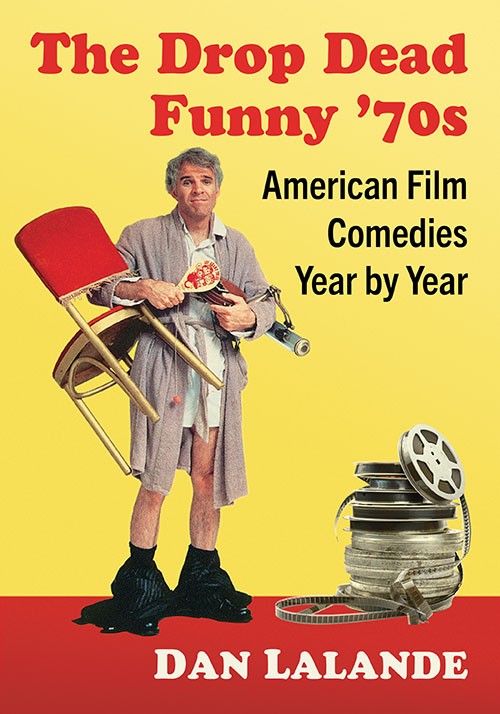
The Drop Dead Funny ’70s: American Film Comedies Year by Year
The first inventory of 130 film comedies released between 1970-’79.
“An entertaining survey of American film comedies from that tumultuous decade in Hollywood history” – Booklist
“Lalande is an astute and thoughtful critic, who offers tasty behind-the-scenes tales of how the films were made and weighs their merits… A knowledgeable, entertaining, and useful critical review of comedy films of the 1970s.” – Library Journal
“A comedy nerd’s delight!” – Patrick McKenna, The Red Green Show
Excerpt from the book:
The Drop Dead Funny 70s: American Film Comedies Year by Year:
A critical guide to 130 film comedies released between 1970-’79
American Graffiti
“American Graffiti is still fun,” asserted, thirty-six years after its release, film historian and critic David Thomson, “and still an honest teenage picture from a time when teenagers kept their fun and their anguish decently to themselves in the certainty that they weren’t worth a hill of beans anywhere else.” In this same entry in his Have You Seen…? Thomson goes on to note the film’s “sly charm,” interpolating nods to its sobriety and modesty.
Justified assessments, yes, but decidedly revisionist. Upon its debut, Graffiti was considered an electric act of cinematic bombast, equally crowned and questioned for its all-out celebration of teenage hijinks. Never before had the Baby Boomers, then still called War Babies, been so cinematically celebrated. The idle, indulgent life they led while creeping up, semi-silently, on adulthood—a life of cruising the main drag, hanging out in burger joints, and benign acts of delinquency—was suddenly presented not as an empty, self-indulgent life stage but as a definitive model of existence. The movies, at this time, were still busy trying to squeeze a dollar out of the previous generation. 1973’s other foray into nostalgia was The Way We Were, a star-based romance covering the gamut from the Dirty Thirties to the MacCarthy portion of the 1950s. Graffiti was out to validate the lives of that generation’s children. As such, it captured something universal (pun intended; Universal produced): a realistic record of the American teenage experience.
It’s Steven Spielberg, generally, who is credited as the father of the “Hollywood Renaissance,” as the emergence of an exciting new crop of young, American filmmaking talent (most mentored by B-king Roger Corman or generational elder statesman Francis Ford Coppola, who produced Graffiti) was initially labeled (approbation belongs to Diane Jacobs for her 1977 book of the same name). But credit for the movement rightly belongs to a quiet, small-town California car nut, George Lucas. Lucas, first by parlaying his own experiences (along with co-screenwriters Willard Huyck and Gloria Katz) into Graffiti, then by regurgitating one of his generation’s guilty TV pleasures—B studio sci-fi serials— into Star Wars (1977), lead the Boomers, Moses-like, into the promised land, delivering them to the major studios as the cash-happy moviegoing audience to be primarily appeased.
First, though, there was Graffiti, a likable cross-stitch of teenage troubles circa 1962 (though really, it’s the late 50s) taking place over a long, single, high beam-lit night. To a decade’s worth of Top Forty chartbusters, mixed so that they sound like they’re coming out of a car radio, a collection of stereotypes—the males: an everyman, a mensch, a tough guy, a nerd; the females: a goody-two-shoes, a tart, a gawky pre-teen—cruise the central strip, try to get laid, and second guess the loom of their next life, whether it be college, romantic commitment, or death. The film, then, while celebrating the best of times (as all of America was at the time: poisoned by Vietnam and the growing Watergate scandal, a collective wish was at work for a time machine that would bring the country back to the serenely sterile) subscribed to a subversive fatalism. They are not long the days of wine and roses—neither, maintained Lucas, those of an illegally acquired pint of Old Harper or of peeling out of Mel’s Drive-in.
Much ballyhooed was the cast—all, except for child star Ron Howard (who soon, thanks to Graffiti, would be cast in TV’s more sanitary version of Graffiti, Happy Days, 1974-’84), had been unknown. It’s little remembered that the prospective Golden Child, according to the critics, was the largely forgotten Paul LeMat as the dimestore James Dean. Even the best-selling soundtrack’s liner notes single him out. The lesson: America loves, above all types, a rebel.
Speaking of soundtracks and rebels, where the hell is Elvis? Not only has Elvis left the building, he’s left the era in which he came to fame. RCA, it ended up, wanted too much money for his tunes. So Lucas settled for Bill Haley, Chuck Berry, The Big Bopper, et al.—not bad for second prize.
Second prizes, in fact, abound: Ron Howard’s character, slated for a promising college career, settles for small-town domesticity; Charles Martin Smith, filmdom’s first realistic nerd, spends the night with a blowsy blonde out of his league (the sexy-sweet Candy Clark, in the film’s only Oscar-nominated performance) only to confess that he is not as he had purported; LeMat, the drag race king, wins the climactic game of chicken against his cowboy-hatted rival (a skinny, shadowy Harrison Ford) but knows, nevertheless, that his days are numbered; Richard Dreyfuss, in a deceptively low-key debut (he’d played bit parts before), suffers a double whammy: first, by being brought to realize that the God to which the kids bow—DJ Wolfman Jack—is but a fabricated persona, then, by never catching up to that blonde in that gleaming white T-Bird. In all cases, the lesson is the same: that there is no God, no silver loving cup, no adolescence in perpetuity (Jacobs, poetically, from her aforementioned book: “It is Eve yearning for her apple, innocent and precocious and scared all at once”).
Life, in the end, is a walk through an automotive graveyard, like the one on which LeMat takes the underage date he is trying to shake (a perfectly punky MacKenzie Phillips). All of us, like America as it weaved its dangerous, crazy way from 1962 to 1973, are destined to end up ghosts of glory.
Heroes of the New Hollywood: Hoffman, Hackman, Nicholson, Pacino, Duvall, and De Niro in the ‘70s
Available at: